
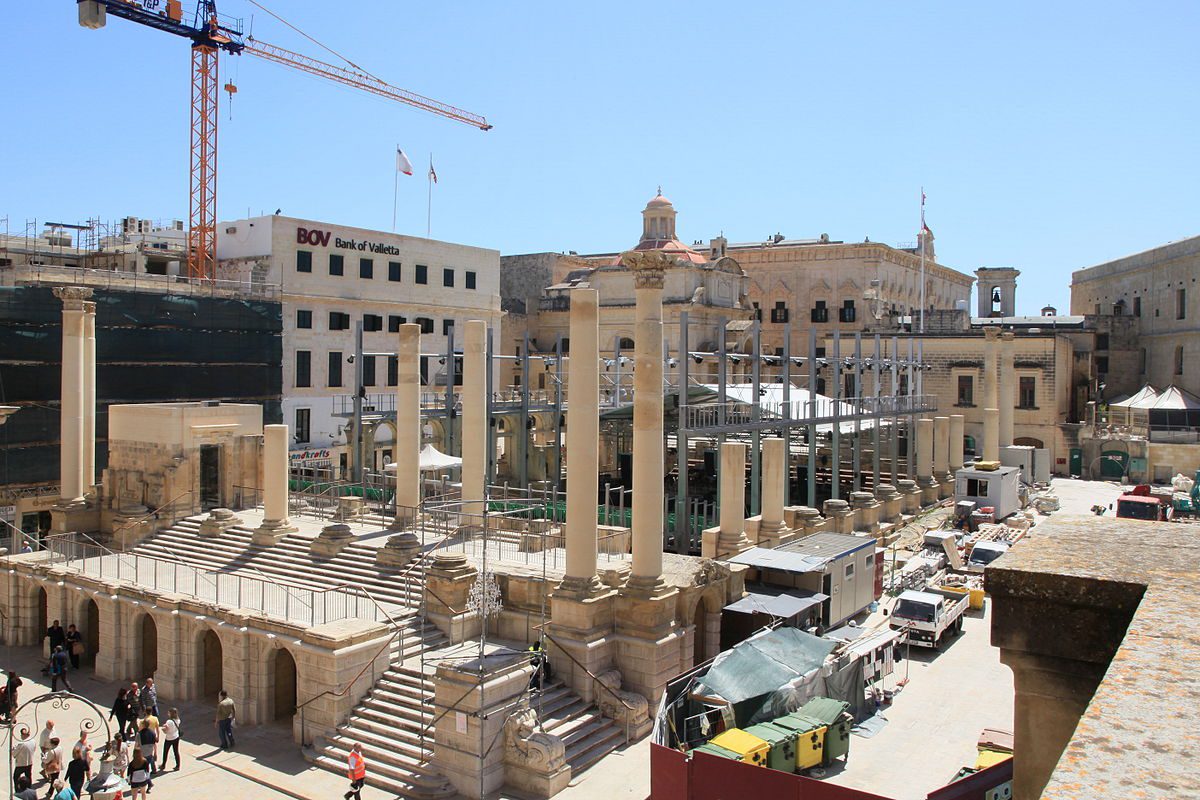

The Royal Opera House
The Royal Opera House, or, It-Teatru Rjal, in Maltese, was an opera house and performing arts venue in Valletta. It had a majestic location at the entrance to Valletta, and stood on Strada Reale (now called Republic Street), flanked by South Street and Ordnance Street.
In the mid-19th century, as opera became more popular in the Maltese Islands, it was felt that the Manoel Theatre, which had opened in 1732, was becoming too small for increasing audiences. In 1860, the Governor of Malta, Sir John Gaspard Le Marchand, formally approved the construction of a new theatre,
The design of the project was entrusted to Edward Middleton Barry, the architect of Covent Garden Theatre, London. He designed the Royal Opera House in the Neo-Baroque style which had become fashionable in Europe at the time. The project started in 1860, although it was delayed when alterations had to be made to Barry’s plans
The building was constructed on a 63 m by 34 m site previously occupied by the Casa della Giornata, the onetime residence of the Turcopilier of the Auberge d’Angleterre during the time of the Knights. It was completed after five years with a seating capacity of 1095 and 200 standing and was inaugurated on October 9, 1866 with Vincenzo Bellini’s opera I Puritani. Its total cost is said to have amounted to £60,000.
Tragedy struck when on 25th May 1873 a fire broke out inside the Opera House and completely destroyed its lavish interiors. The façade and exterior, fortunately, remained almost intact, and reconstruction was soon underway to restore it to its former glory. On 11th October 1877, the Opera House opened its doors once again, to Giuseppe Verdi’s Aida. In 1895, electricity replaced the use of gas to illuminate the theatre.
During its years of existence, the Royal Opera House was the focal point of Maltese cultural life and classical music. Some of the most famous opera singers of the time, such as Gianna Pederzini, Antonio Scotti and Mariano Stabile, performed here in its earliest years. The Royal Opera House also housed some of the world’s most important musical pieces, amongst which, those composed by Bizet, Verdi and Donizetti.
The Royal Opera House was considered to be one of the most beautiful and inspiring Opera Houses in Europe. This was therefore the theatre where Maltese singers and musicians aspired to commence their career.
Sadly, in 1942, after weeks of fierce air raids by the German Luftwaffe, the Royal Opera House was bombed repeatedly until part of the ceiling and a corner collapsed inward on the evening of Tuesday, 7 April 1942. A few years later, the building was dismantled for safety reasons. Although the stones were numbered and stored, they were eventually dispersed and in spite of repeated electoral promises, the reconstruction of the Opera House was destined not to be.
Today, the ruins of the Opera House have been converted into an open-air theatre- Pjazza Teatru Rjal. It was officially inaugurated on August 8, 2013. Pjazza Teatru Rjal provides a diverse programme of high calibre, topped up with the unique experience of an open air performance space within Malta’s capital city.